Banks must validate their AML models
The CBN's March 2026 baseline standards require independent validation of automated AML detection. That needs evidence an examiner can re-check, not a vendor's word.
 Litt
A reference implementation of §5.5(b)(i) of the CBN's Baseline Standards for Automated AML Solutions: run one bank ledger through two independent agents, then score the detection logic on the four legs that requirement implies.
The CBN's March 2026 baseline standards require independent validation of automated AML detection. That needs evidence an examiner can re-check, not a vendor's word.
A prebuilt Eino ReAct agent and a hand-rolled compose.Graph pass run the same tools over the ledger. A Go validator scores the run; the app only renders its trace and report artifacts.
On the fixture: 5 findings, 100% precision and recall, both passes agree. The drift variant drops recall to 80% and the report explains why. Real uploads show 'no ground truth' instead of a number.
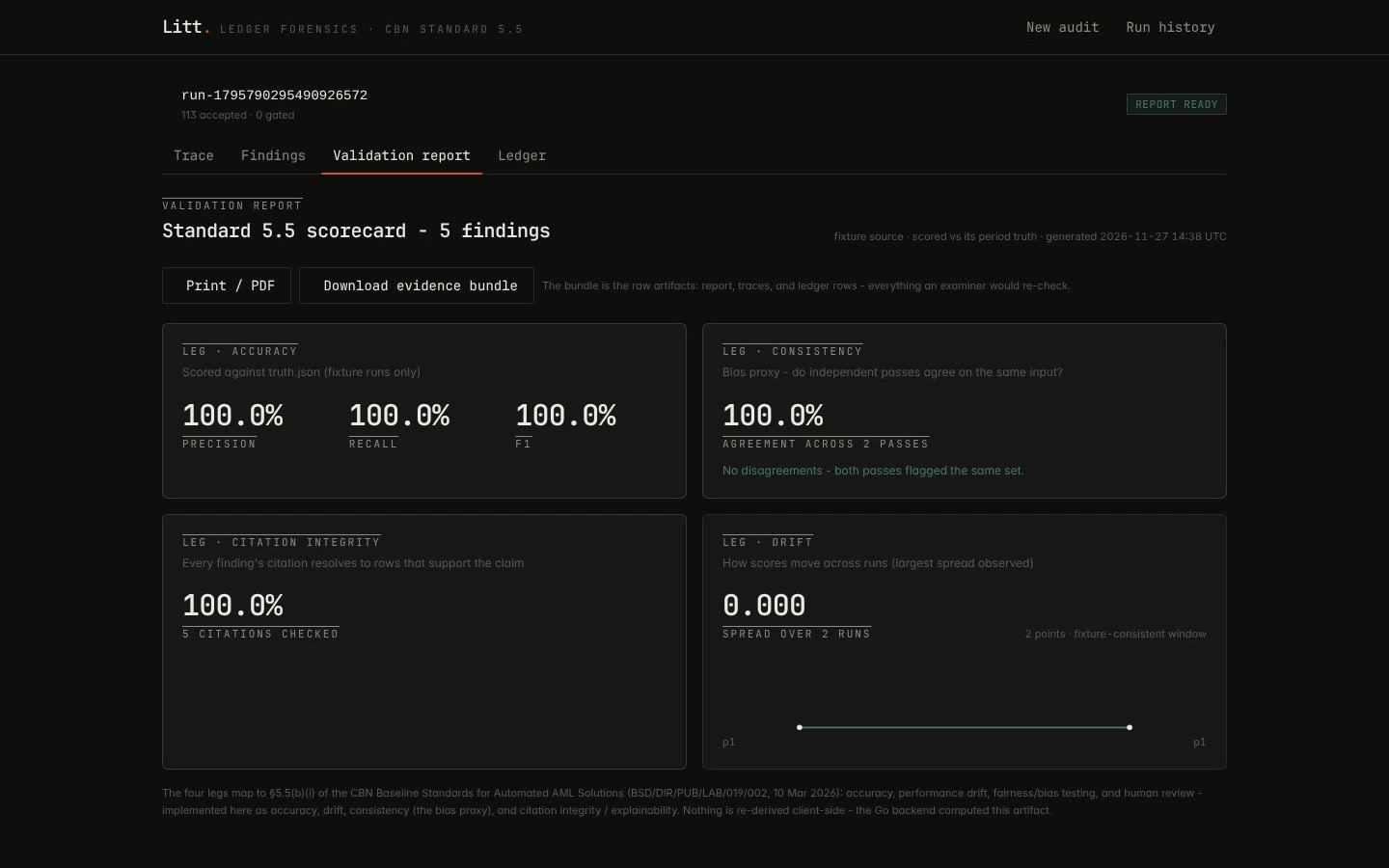
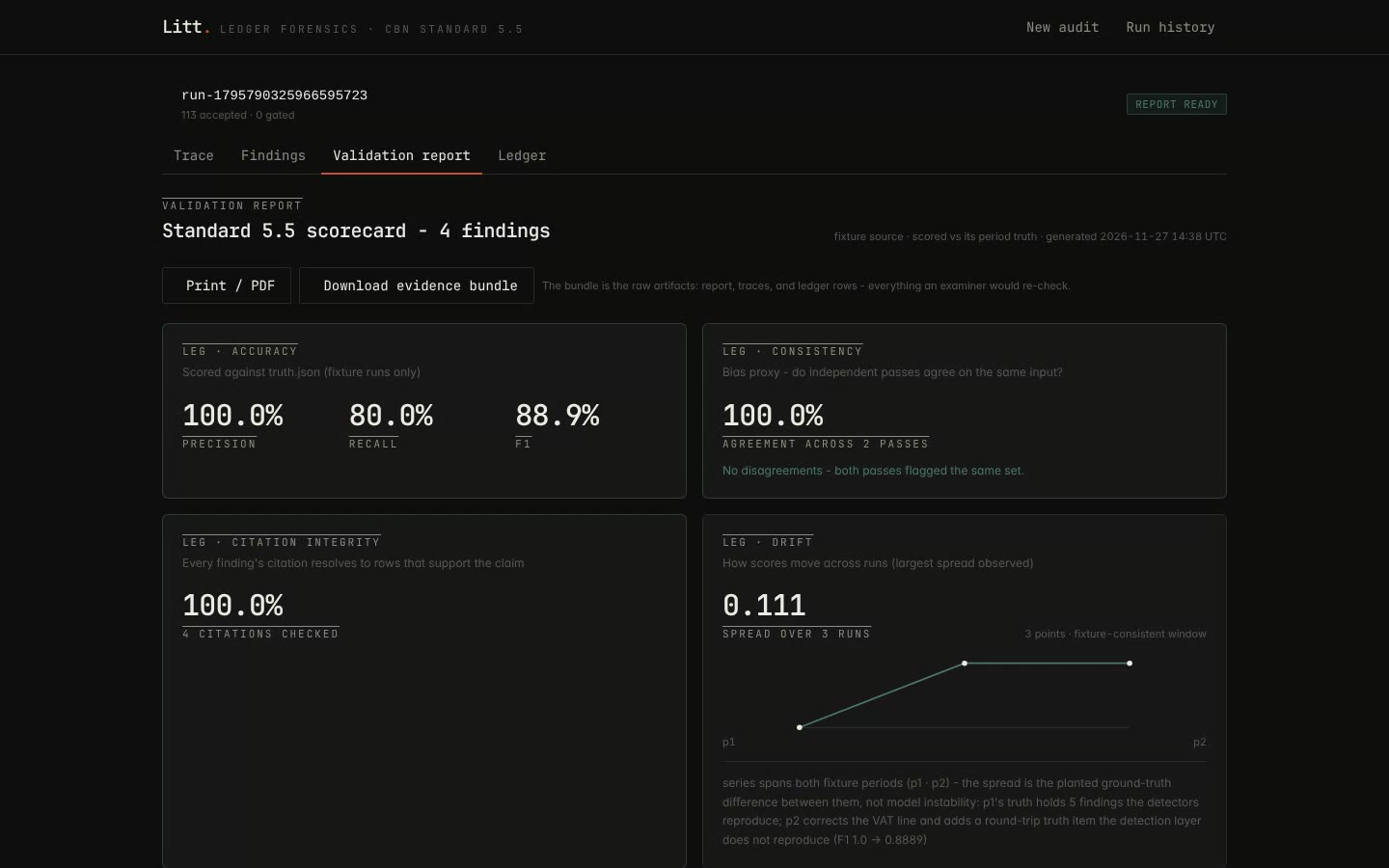
The trace is the contract: every tool call is logged with what it saw, and every finding cites a CBN clause and resolves back to rows in the source ledger. Without an API key, Litt runs on a deterministic stub model that doubles as the test oracle.